
Research
Research · University of Nevada, Reno
Controllable, verifiable, and physically grounded generative AI
Generative models can now produce realistic images and videos, but we still have limited ability to remove what they should not generate or to make what they generate obey the physical world, and forged media are increasingly hard to tell apart from real content. Our group develops methods that diagnose what a model has learned, intervene on it selectively, and verify the result.
Our approach
Direction oneConcept Erasure and Machine Unlearning
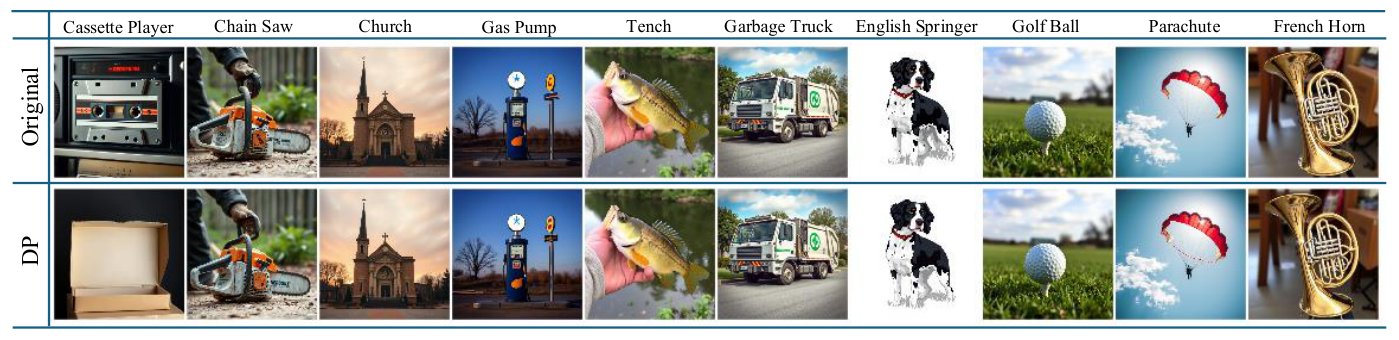
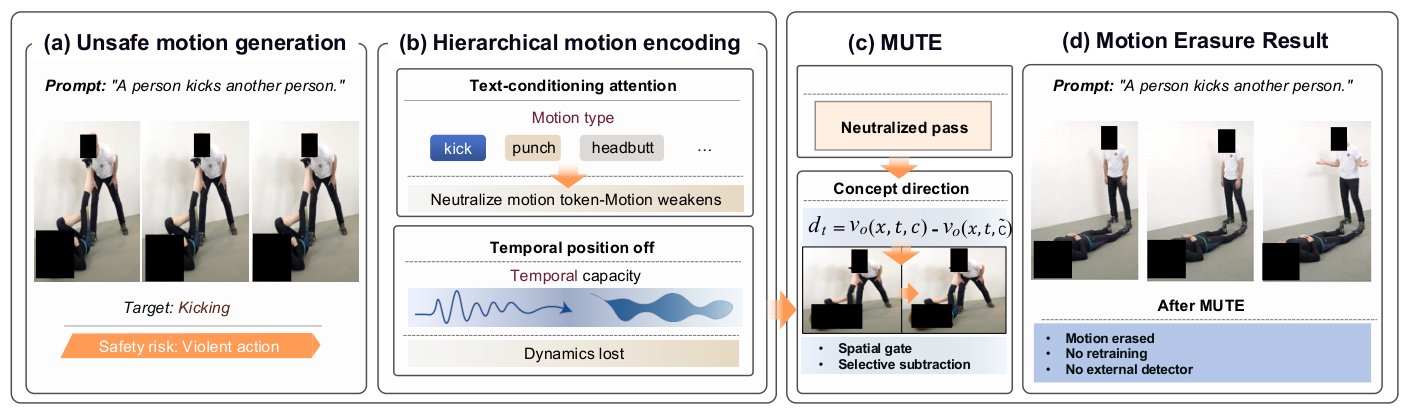
Text-to-image and text-to-video models can generate content that should be removed after deployment, such as copyrighted styles, specific objects, or violent actions. Concept erasure removes a target concept from a pretrained model while leaving everything else intact. We extend erasure from static concepts in images to motion concepts in videos.
Representative papers
- CVPR 2026Closed-Form Concept Erasure via Double ProjectionsChi Zhang, Jingpu Cheng, Zhixian Wang, Ping Liu†arXiv
- ICLR 2026Machine Unlearning under Retain–Forget EntanglementJingpu Cheng, Ping Liu, Qianxiao Li, Chi Zhang
- ICML 2026Where Concept Erasure Should Occur: Concept–Layer Alignment in Text-to-Video Diffusion ModelsYiwei Xie, Ping Liu†, Zheng Zhang†
- ACM MM 2026
- NeurIPS 2026DOME: Drift-Adaptive On-Policy Motion Erasure in Video Diffusion TransformersPing Liu, Chi Zhang, Meng Tang
- TMLR 2026ABCDE: Agentic-Based Controlled Dynamic Erasure for Intent-Aware Safety ReasoningPing Liu, Chi Zhang
- arXiv 2026PROBE: Diagnosing Residual Concept Capacity in Erased Text-to-Video Diffusion ModelsYiwei Xie, Zheng Zhang†, Ping Liu†arXiv
Direction twoPhysically Grounded Text-to-Video Generation
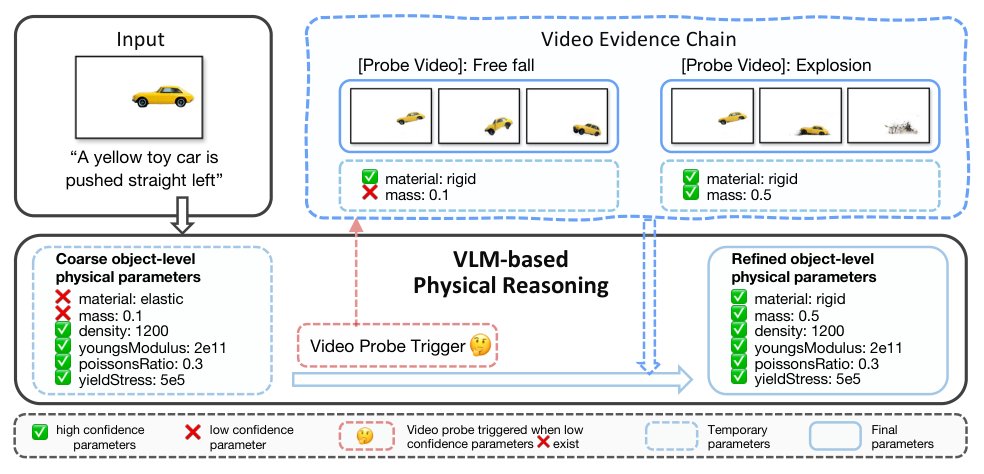
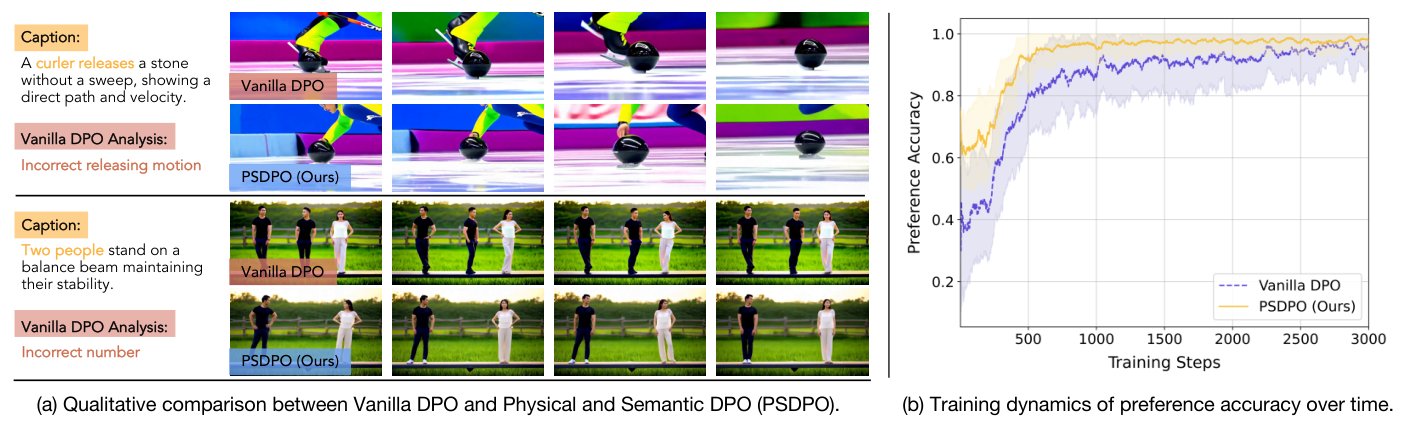
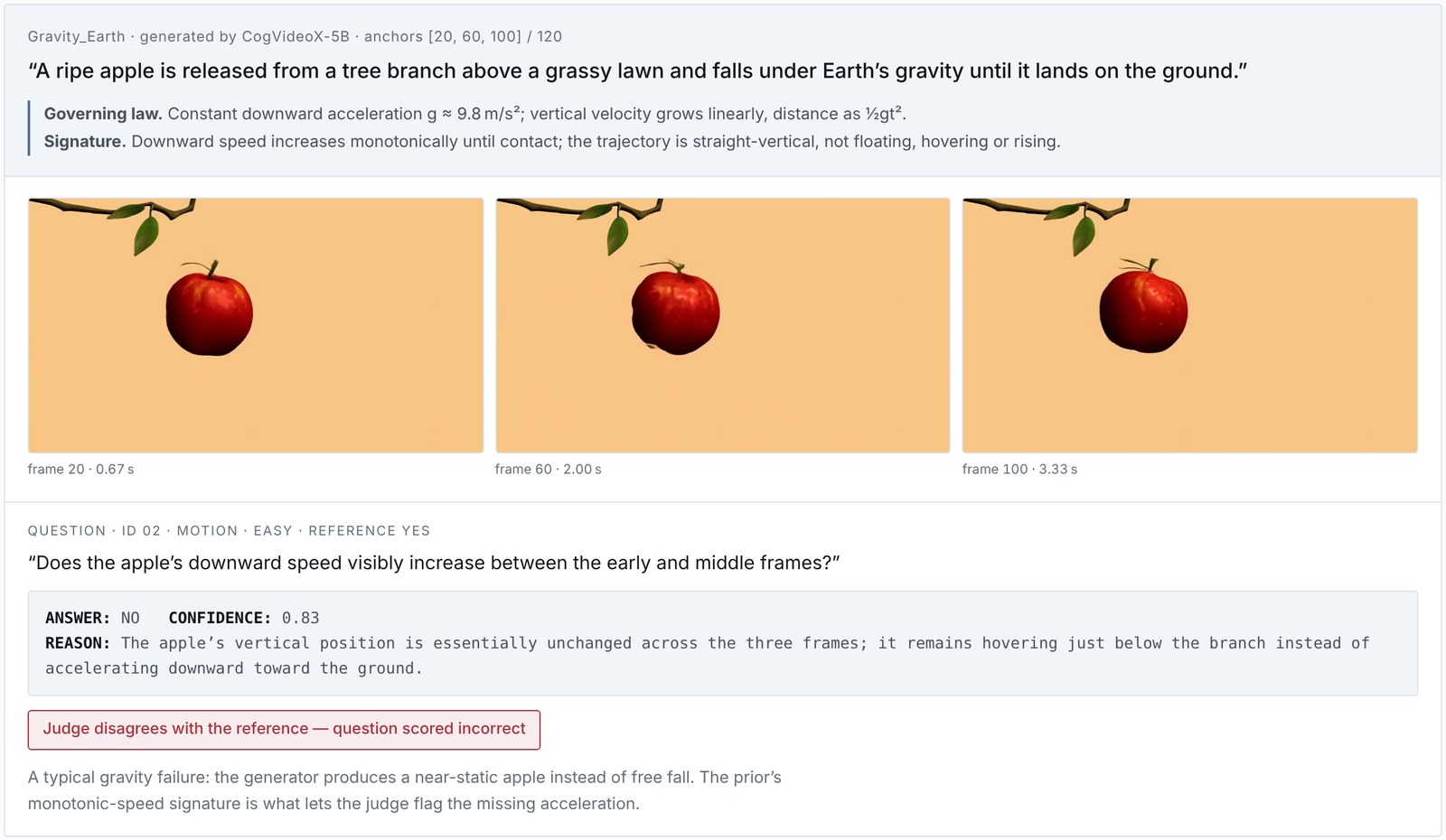
Current video generators produce visually realistic results that often violate basic physics: objects pass through one another, motion ignores mass and material, and dynamics drift over time. We work on making generated motion physically consistent while keeping it faithful to the prompt.
Representative papers
- ECCV 2026PhyMAGIC: Physical Motion-Aware Generative Inference with Confidence-Guided VLMSiwei Meng, Yawei Luo†, Ping Liu†Project page
- ACM MM 2026
OralWhen Physical Preferences Meet Semantic Constraints: Physical and Semantic Direct Preference Optimization for Text-to-Video GenerationSiwei Meng, Yawei Luo, Shu Zhang, Ping Liu†arXiv - NeurIPS 2026PhyMetric: Diagnosing Physical Plausibility in Text-to-Video Generation via Scene-Level QASiwei Meng, Xuerou Cai, Rui Hu, Ping Liu† · Evaluations and Datasets TrackProject page Code
- IJCAI 2025Grounding Creativity in Physics: A Brief Survey of Physical Priors in AIGCSiwei Meng, Yawei Luo†, Ping Liu† · Survey TrackarXiv
Direction threeDeepfake Detection and Media Forensics
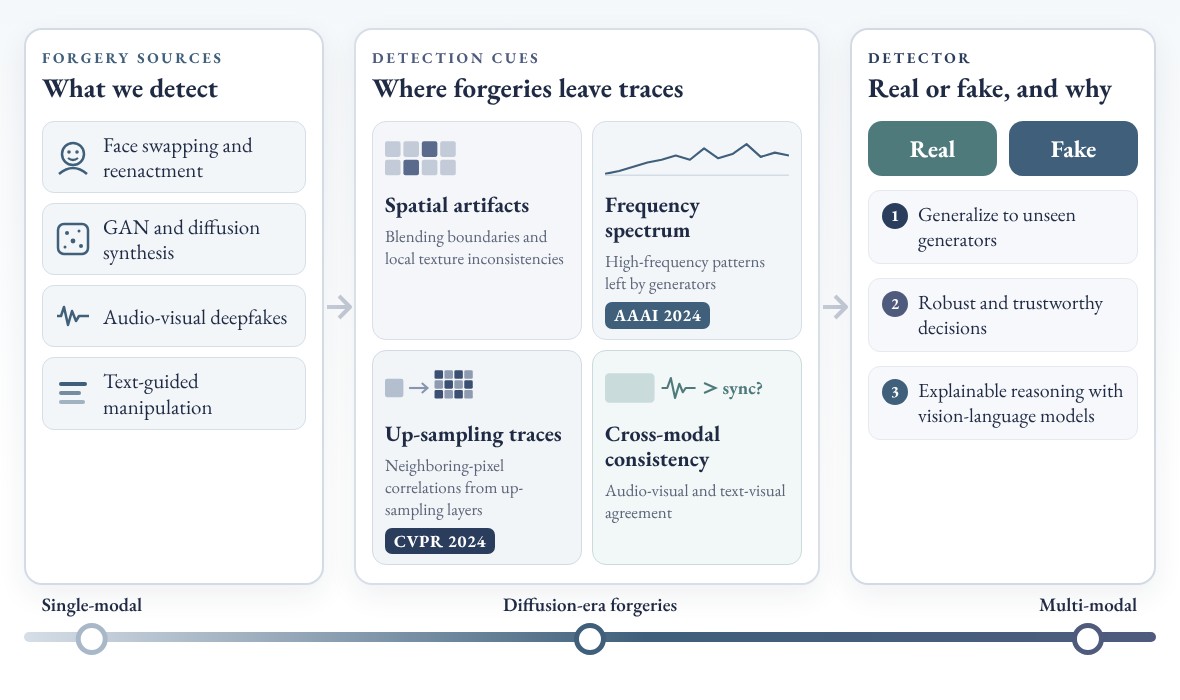
The same generative models also make it easy to forge faces, voices, and text-guided edits. We build detectors that generalize to forgeries from generators never seen during training, by targeting the traces that generators leave behind, and we study how detection is moving from single-modal to multi-modal settings.
Representative papers
- WIFS 2025ADD: An Automated Neural Architecture Search Baseline for Deepfake DetectionPing Liu, Yuewei Lin, Jingen Liu, Yunchao Wei, Joey Tianyi Zhou
- ACM MM 2024
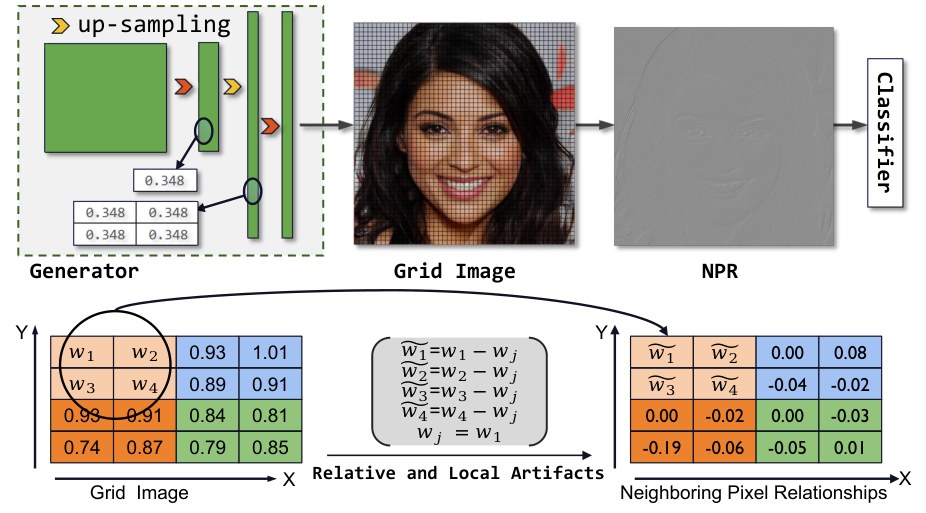
WorkshopRobust Deepfake Detection by Addressing Generalization and Trustworthiness Challenges: A Short SurveyPing Liu, Qiqi Tao, Joey Tianyi Zhou · Best Paper Award (Survey) - CVPR 2024Rethinking the Up-Sampling Operations in CNN-based Generative Network for Generalizable Deepfake DetectionChuangchuang Tan, Yao Zhao, Shikui Wei, Guanghua Gu, Ping Liu, Yunchao WeiPaper
- AAAI 2024Frequency-Aware Deepfake Detection: Improving Generalizability through Frequency Space Domain LearningChuangchuang Tan, Yao Zhao, Shikui Wei, Guanghua Gu, Ping Liu, Yunchao Wei
- arXiv 2024Evolving from Single-modal to Multi-modal Facial Deepfake Detection: A SurveyPing Liu, Qiqi Tao, Joey Tianyi ZhouarXiv
Other directions
Dataset Distillation
We also study dataset distillation, which compresses a large training set into a small synthetic one that preserves what models learn from it, with attention to efficiency, robustness, and pre-trained vision models.
- NeurIPS 2026Closed-Form Linear-Probe Dataset Distillation for Pre-trained Vision Models [arXiv]Bincheng Peng, Guang Li, Ping Liu, Takahiro Ogawa, Miki Haseyama
- ICLR 2025Breaking Class Barriers: Efficient Dataset Distillation via Inter-Class Feature CompensatorXin Zhang, Jiawei Du, Ping Liu, Joey Tianyi Zhou
- TIP 2025DD-RobustBench: An Adversarial Robustness Benchmark for Dataset DistillationYifan Wu, Jiawei Du♠, Ping Liu♠, Yuewei Lin, Wenqing Chen, Wei Xu
- ICLR 2023Meta Knowledge Condensation for Federated LearningPing Liu♠, Xin Yu♠, Joey Tianyi Zhou
Facial Expression Analysis
Earlier work, beginning with Ping Liu's Ph.D. research, developed deep and sparse representation methods for facial expression recognition and facial action analysis.
- CVPR 2014Facial Expression Recognition via a Boosted Deep Belief NetworkPing Liu♠, Shizhong Han♠, Zibo Meng, Yan Tong
- ECCV 2014Feature Disentangling Machine: A Novel Approach of Feature Selection and Disentangling in Facial Expression AnalysisPing Liu, Joey Tianyi Zhou, Ivor Tsang, Zibo Meng, Shizhong Han, Yan Tong
- FG 2017Identity-Aware Convolutional Neural Network for Facial Expression RecognitionZibo Meng♠, Ping Liu♠, Jie Cai, Shizhong Han, Yan Tong
- TCYB 2021Point Adversarial Self Mining: A Simple Method for Facial Expression RecognitionPing Liu, Yuewei Lin, Zibo Meng, Lu Lu, Weihong Deng, Joey Tianyi Zhou, Yi Yang
Open resources


† corresponding or co-corresponding author; ♠ equal contribution. The full list is on the Publications page.